Blog

  • Advanced VoIP Features: Call Recording, IVR, and Call Queues

    Advanced VoIP Features: Call Recording, IVR, and Call Queues

    Learn how advanced VoIP features like call recording, IVR, and call queues help businesses improve support quality, performance metrics, and customer satisfaction.

    VoIP has become smarter — and more strategic

    Modern IP telephony is no longer just about cutting call costs. It’s a powerful platform for optimizing support, training teams, and monitoring communication across the business.

    If you’re only using VoIP to save money, it’s time to discover its advanced features that drive real business value.

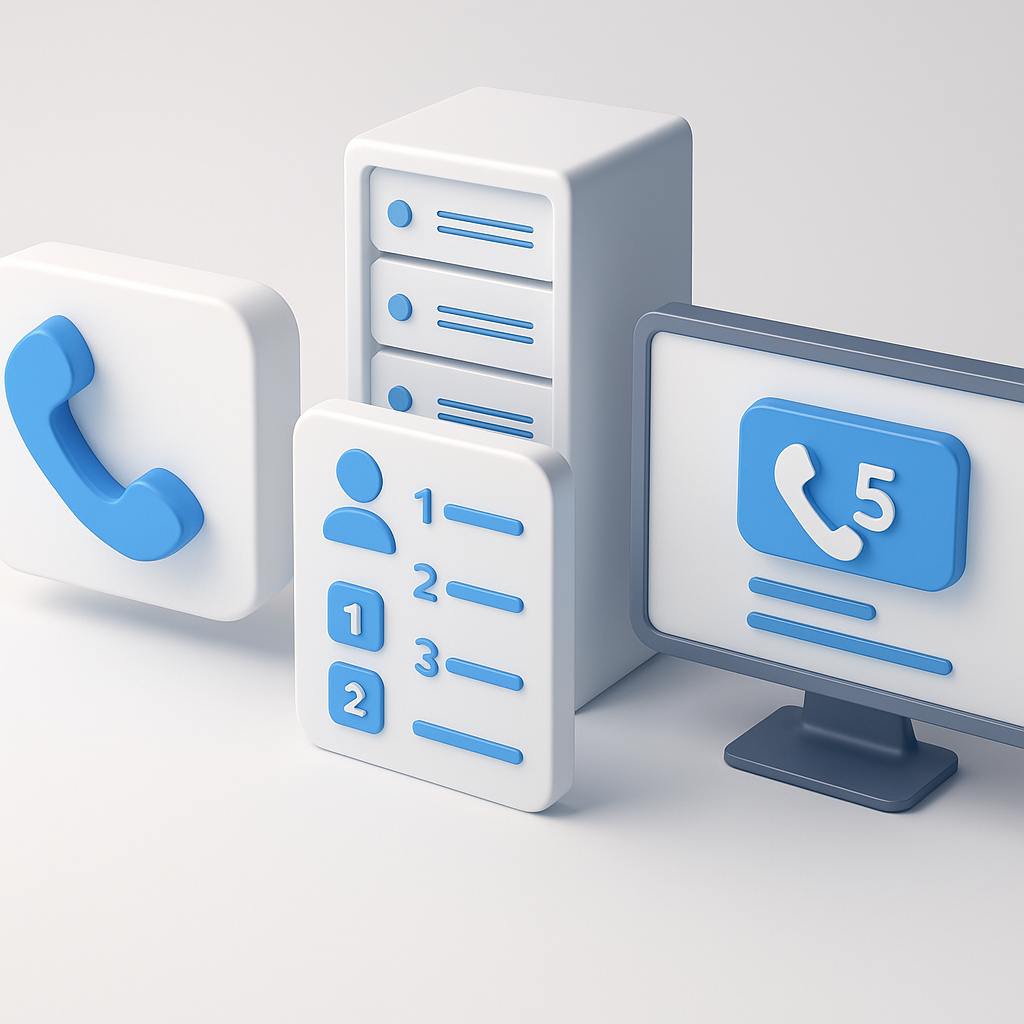
    📞 Call Recording

    What is it?

    The ability to automatically log and store all inbound and outbound voice calls.

    Benefits:

    • Quality assurance for customer service
    • Compliance with legal or internal policies
    • Training and coaching for sales and support agents
    • Legal documentation for contract or dispute resolution

    Use cases:

    From startups to call centers, recording helps ensure accountability and track conversation history.

    ☎️ IVR (Interactive Voice Response)

    What is it?

    That automated menu you hear when calling a business (“Press 1 for Support, 2 for Sales…”). With VoIP, it’s fully customizable and can connect with external databases.

    Benefits:

    • Organizes inbound call flow
    • Routes calls to the right department or agent
    • Reduces wait times
    • Creates a professional, branded experience

    Examples:

    You can build a multi-level IVR, use number recognition to pull customer data, or set seasonal announcements automatically.

    🧑‍💼 Call Queues

    What are they?

    When all agents are busy, calls are placed in a queue with music, wait time updates, and messages — until an agent is available.

    Benefits:

    • Prevents lost calls during high demand
    • Balances call distribution among teams
    • Improves customer satisfaction with accurate wait times
    • Provides real-time metrics: average wait, abandoned calls, agent efficiency

    💼 L7CORE: Advanced VoIP Built for Business

    L7CORE delivers a complete VoIP platform with:

    • Secure cloud-based call recording
    • Custom IVR with full logic control
    • Call queueing with dynamic distribution
    • Dashboard with real-time reporting
    • Human support when it matters most
    🔵 Upgrade your business communication. Talk to L7CORE.

  • Modern Business VoIP: Beyond Cost Savings

    Modern Business VoIP: Beyond Cost Savings

    Business VoIP has evolved. Learn how it goes beyond reducing costs by enabling mobility, integration, scalability, and secure communications for modern companies.

    VoIP is no longer just about cheap calls

    For years, VoIP (Voice over IP) was seen as a low-cost alternative to landlines. But today, it’s a strategic communications tool that empowers businesses to stay connected from anywhere, integrate with software, and scale easily.

    🚀 Key benefits of modern VoIP

    1. Mobility and remote work

    Answer business calls on your mobile or computer — from anywhere in the world.

    2. Integration with platforms

    Sync with CRMs, support tools, and team collaboration systems.

    3. Scalable infrastructure

    Easily add extensions and features without physical hardware.

    4. Real-time monitoring

    Track call data, agent performance, and usage insights in real time.

    5. Secure communication

    End-to-end encryption and centralized user access control.

    💡 Common use cases

    • Distributed customer support centers
    • Remote and hybrid teams
    • Multi-site businesses and franchises
    • Sales teams integrated with CRMs
    • Mobile-enabled support agents

    🔵 L7CORE: Business-Grade VoIP Built for Growth

    With L7CORE’s enterprise infrastructure, you get:

    • Crystal-clear audio quality
    • Custom system integrations
    • Real support in your language
    • Easy-to-use dashboards

    Upgrade your communications. Talk to L7CORE.

  • The Future of Anti-DDoS Protection: Emerging Threats and Technologies

    The Future of Anti-DDoS Protection: Emerging Threats and Technologies

    Explore how anti-DDoS protection is evolving to counter more intelligent and multi-layered threats. Discover the technologies shaping the future of cybersecurity.

    The rise of modern DDoS attacks

    DDoS attacks are no longer just brute-force floods — they’ve become intelligent, layered, and adaptive. The growing use of IoT, APIs, and cloud infrastructure expands the attack surface, requiring modern defenses to evolve fast.

    🔍 Key DDoS threat trends

    1. Hybrid and multi-vector attacks

    Combine volumetric, protocol, and application-layer methods in one synchronized wave, overwhelming traditional single-layer defenses.

    2. AI-driven botnets

    Bots that change attack patterns in real-time to evade signature-based detection.

    3. API-based DDoS vectors

    Exploiting open or public APIs to trigger resource exhaustion or reflection attacks.

    🚀 Technologies defining the future of DDoS defense

    AI-powered mitigation

    Adaptive systems that learn normal traffic and automatically identify anomalies in real-time.

    Edge-based protection with Anycast

    DDoS traffic is absorbed closer to the source, reducing latency and core risk.

    WAF + Zero Trust integration

    Layer 7 protection works in tandem with identity-based access models.

    Behavioral and IP reputation analysis

    Mitigation becomes more nuanced — based on trust scores, patterns, and intent.

    🛡️ L7CORE and the future of protection

    L7CORE is at the forefront of next-gen DDoS mitigation, combining:

    • AI-driven learning systems
    • Geo-distributed infrastructure
    • L3-L7 multi-layer firewalls
    • Real-time technical support

    🔵 Is your system ready for the next wave of threats?
    Ask L7CORE for a free infrastructure risk assessment.

  • Understanding the Different Types of DDoS Attacks: Volumetric, Protocol, and Application Layer

    Understanding the Different Types of DDoS Attacks: Volumetric, Protocol, and Application Layer

    DDoS attacks are among the most frequent cyber threats on the internet. Learn how the main types — volumetric, protocol, and application — work and how to defend your infrastructure.

    What is a DDoS attack?

    DDoS stands for Distributed Denial of Service. It is a malicious attempt to make a service, server, or network unavailable by overwhelming it with an excessive volume of traffic or requests.

    Unlike a traditional DoS attack launched by a single machine, DDoS uses multiple compromised devices (botnets) to launch a coordinated and large-scale attack.

    🔹 Most common types of DDoS attacks

    DDoS attacks are generally classified into three main categories based on the OSI model layer they target:

    1. 🌊 Volumetric Attacks (Layers 3 and 4)

    How they work:

    Flood the target with massive volumes of data (UDP, ICMP, TCP packets), aiming to saturate the bandwidth of the target network or its upstream infrastructure.

    Examples:

    • UDP Flood
    • ICMP Flood (Ping Flood)
    • Amplification Attacks using DNS, NTP, or Memcached servers

    Characteristics:

    • Extremely high traffic volume (Gbps or Tbps)
    • Easy to execute using public tools and botnets
    • Immediate impact on overall connectivity

    Mitigation:

    • Cloud-based mitigation services
    • Smart blackholing and traffic filtering
    • ACL rules and rate limiting at the edge

    2. 🧱 Protocol Attacks (Layers 3 and 4)

    How they work:

    Exploit vulnerabilities in TCP/IP protocol stacks to exhaust resources of servers, firewalls, or load balancers.

    Examples:

    • SYN Flood: Initiates TCP connections without completing them
    • ACK Flood: Sends invalid ACK packets to confuse routing logic
    • Ping of Death, Smurf Attacks

    Characteristics:

    • Use seemingly legitimate packets
    • Target connection/session capacity and memory buffers
    • Lower volume but high impact

    Mitigation:

    • Stateful firewalls with deep packet inspection
    • Invalid packet filtering
    • TCP challenge-response mechanisms (SYN cookies)

    3. 🧠 Application Layer Attacks (Layer 7)

    How they work:

    Target web applications or APIs by mimicking real user behavior to consume backend resources (CPU, memory, database queries).

    Examples:

    • HTTP Flood (GET or POST)
    • Slowloris: Keeps connections open slowly to exhaust web servers
    • Login, search, or checkout abuse

    Characteristics:

    • Difficult to detect — traffic appears legitimate
    • Low bandwidth, high resource impact
    • Requires behavioral analysis and adaptive filtering

    Mitigation:

    • Web Application Firewalls (WAFs)
    • Rate limiting and bot detection
    • CAPTCHA, MFA, and behavioral threat intelligence

    ⚠️ DDoS attack consequences

    • Partial or total service outage
    • Revenue and brand damage
    • High mitigation and recovery costs
    • Operational distraction for technical teams — leaving doors open for other threats

    🛡️ How L7CORE helps defend against DDoS

    At L7CORE, we provide high-availability infrastructure with advanced DDoS protection, including:

    • Multi-layer filtering (L3, L4, and L7)
    • Real-time traffic anomaly detection
    • Integrated mitigation with AI-based analytics
    • Redundant networks and expert support

    🔵 Worried about DDoS?
    Talk to an L7CORE specialist and see how we can protect your infrastructure.

  • How White Label Cloud Boosts MSP and IT Reseller Businesses

    How White Label Cloud Boosts MSP and IT Reseller Businesses

    Discover how L7CORE’s white label cloud helps MSPs and IT resellers grow by offering branded cloud services with full control and scalable profits.

    A strategic opportunity for resellers

    The MSP and IT services market is more demanding than ever. Clients want all-in-one solutions, with security, scalability, and reliability. That’s where white label cloud stands out — enabling you to offer branded cloud services without managing infrastructure.

    What is White Label Cloud?

    It’s a model where you sell cloud services under your brand, while L7CORE provides the underlying infrastructure, uptime and support. You own the customer relationship, we handle the technology.

    Why MSPs and resellers benefit

    Fast time to market
    Launch your branded cloud in days — no need for a data center.

    Powerful L7CORE infrastructure
    Servers, networking, backups and control panels included.

    Full pricing control
    You choose the plans and set your profit margin.

    Guaranteed SLA and real support
    L7CORE maintains performance behind the scenes.

    Custom branding
    Your clients interact only with your brand — we stay invisible.

    What services can you resell?

    • Managed hosting
    • Custom VPS
    • Private/public cloud
    • Secure storage and backup
    • Branded management portals

    Already in IT? White label helps you grow

    If you already offer:

    • Outsourced support
    • Managed infrastructure
    • IT consulting
    • Hardware/software resale

    Then you’re ready to expand with white label cloud.

    Partner with L7CORE

    L7CORE provides the technical backbone so you can operate as a full-fledged cloud provider, focusing on results, brand ownership, and growth.

    🔵 Talk to an expert and activate your white label cloud today.

  • White Label Cloud: Launch Your Own Branded Cloud Services with L7CORE

    White Label Cloud: Launch Your Own Branded Cloud Services with L7CORE

    Offer your own cloud services under your brand using L7CORE’s infrastructure. Learn how our white label cloud model helps you grow with zero upfront investment.

    What is White Label Cloud?

    White label cloud allows you to sell cloud computing services under your own brand, while the infrastructure is fully managed by a partner like L7CORE.

    Your name, your branding, your pricing — all powered by our technology.

    Benefits of L7CORE’s White Label Model

    Infrastructure ready for resale
    Servers, panels, backups, networks, and more — already built.

    Fully branded platform
    Custom control panels, your logo, your domain.

    Scalable profit
    You set the final price and keep the margin.

    Expert technical support
    L7CORE’s team ensures stability and resolution behind the scenes.

    Quick launch
    No need to invest in infrastructure — go live in days.

    What can you offer with White Label Cloud?

    • Website hosting and VPS
    • Private or public cloud
    • Cloud storage
    • Branded management dashboards
    • Reselling to agencies, ISPs, businesses and final clients

    Who is this for?

    • Internet service providers (ISPs)
    • Tech or digital agencies
    • SaaS and software companies
    • IT consultants and resellers
    • Regional datacenters scaling operations

    Start with L7CORE

    With L7CORE, you get enterprise-grade infrastructure, custom-branded panels, guaranteed SLA, and support in your language, with scalable pricing plans.

    🔵 Want to launch your own cloud brand?
    Contact L7CORE and activate your white label cloud today.

  • Colocation: The Smart Solution for Hosting Your Equipment

    Colocation: The Smart Solution for Hosting Your Equipment

    Discover how colocation allows your company to host its own servers in a secure and reliable data center environment with full hardware control and high connectivity.

    What is Colocation?

    Colocation is a hosting service that enables your business to place its own servers and hardware in a professional data center, benefiting from redundant power, cooling, physical security, and high-speed connectivity — all while maintaining full control over your equipment.

    Key benefits of Colocation

    Lower operational costs
    No need to build your own infrastructure — save on power, cooling, and security.

    High connectivity and uptime
    Data centers provide multiple ISP links and maximum service availability.

    Secure and monitored environment
    Access control, surveillance, and 24/7 support protect your physical assets.

    Scalability as needed
    Easily expand your resources by adding racks or bandwidth.

    Full control of your hardware
    You manage the servers, systems, and configurations — total freedom.

    When is Colocation the right choice?

    • Companies with existing servers seeking more stable environments
    • Service providers requiring high reliability
    • Projects needing physical control over servers
    • Businesses subject to compliance and audits

    L7CORE: The Right Partner for Colocation

    With Tier III and IV data centers across Brazil and abroad, L7CORE offers:

    • Guaranteed SLA and redundant infrastructure
    • Carrier-neutral connectivity
    • Controlled physical and remote access
    • 24/7 support with expert technicians

    🔵 Ready to host your servers with reliability and control?
    Talk to our team and explore our colocation plans.

  • 3 Common Mistakes When Choosing Hosting — and How to Avoid Them

    3 Common Mistakes When Choosing Hosting — and How to Avoid Them

    Don’t let a bad hosting decision cost you time and money. Learn the 3 most common mistakes companies make — and how to avoid them.

    Choosing a hosting provider may seem straightforward — until something goes wrong. Many businesses choose based solely on price or speed to launch, and later regret it. In this article, we reveal the three most common hosting mistakes and what to look for to ensure stability, performance, and expert support

    1️⃣ Focusing only on price

    The cheapest plan often hides major issues:

    • Frequent downtime during traffic spikes
    • Limited resources (CPU, RAM, bandwidth)
    • Slow or unresponsive support

    💡 Solution: Look for value, not just low cost. Consider SLA, dedicated resources, and the provider’s reputation.

    2️⃣ Overlooking the infrastructure type

    Many users don’t even know whether they’re getting:

    • Shared hosting
    • VPS
    • Cloud
    • Dedicated
    • Bare metal

    Each structure has a direct impact on speed, security, and scalability.

    💡 Solution: Know your application. For demanding systems, cloud, dedicated, or bare metal hosting is often the right call.

    3️⃣ Ignoring technical support

    Support is underestimated — until an outage hits and nobody responds.

    • Limited to business hours
    • Slow ticket resolution
    • Lack of skilled technicians

    💡 Solution: Choose providers with 24/7 expert support, clear SLAs, and fast resolution times. Peace of mind comes from knowing help is always available.

    Hosting is not just about disk space or bandwidth — it’s about ensuring the stability of your digital operation.

    🔵 At L7CORE, we offer more than just servers. We deliver infrastructure built for resilience, with 24/7 expert support and tailored hosting solutions.

    Talk to our team and discover what professional-grade hosting really means.

  • Migrating to a Professional Data Center: The Essential Checklist

    Migrating to a Professional Data Center: The Essential Checklist

    Planning to migrate your infrastructure to a professional data center? Here’s a technical checklist to ensure a secure, efficient and scalable transition.

    Why migrate to a professional data center?

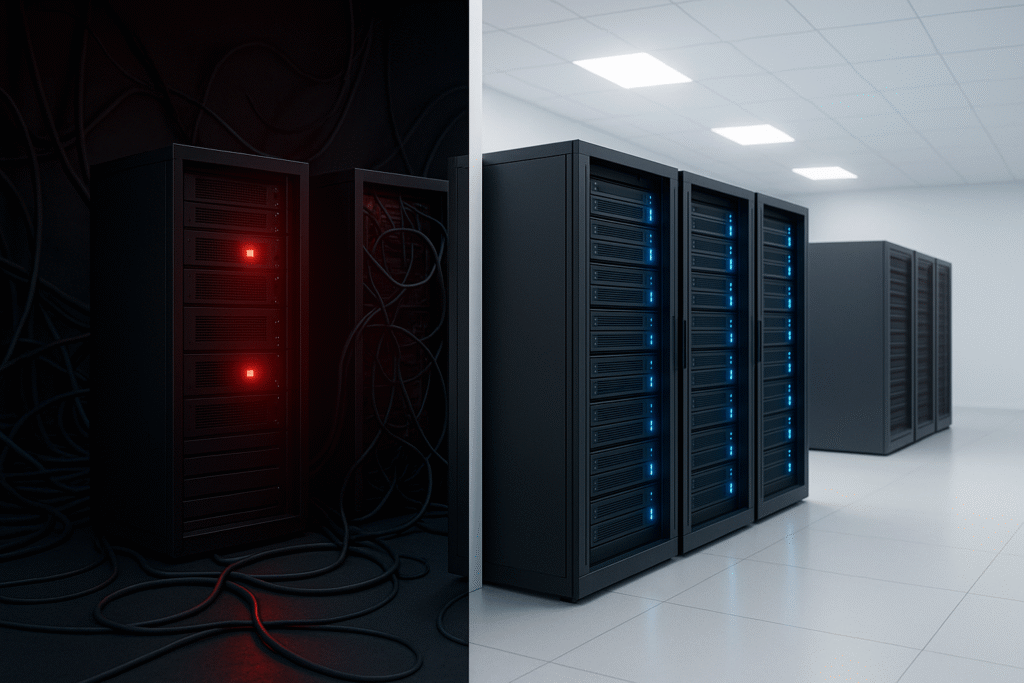
    Growing businesses inevitably hit infrastructure limits. A professional data center offers:

    • High availability (uptime)
    • Physical and cyber risk reduction
    • On-demand scalability
    • Consistent performance with expert support

    But a smooth transition starts with a proper checklist.

    ✅ Essential Checklist for a Safe Migration

    1. 📦 Audit your current inventory

    • What systems and applications will be moved?
    • Are there any interdependencies?
    • Any legacy systems that need adaptation?

    Perform a full technical mapping before moving anything.

    2. 🔐 Define your security requirements

    • Do you need dedicated firewalls?
    • What encryption standards are in place?
    • Are you subject to LGPD, HIPAA, PCI-DSS, etc.?

    The data center must offer compliance, physical isolation, and continuous monitoring.

    3. 🌐 Plan your connectivity

    • Will you need a dedicated link, BGP, or multiple carriers?
    • Is there redundancy?

    Low latency and resilience are non-negotiable for real-time services.

    4. 📈 Forecast growth and scalability

    • How fast is your traffic or resource usage growing?
    • Can the provider scale vertically and horizontally?

    Plan for tomorrow, not just today.

    5. 👨‍💻 Confirm support and SLA

    • Is 24/7 expert human support included?
    • What’s the average incident response time?
    • Can you speak directly with engineers?

    Without real support, even great infrastructure fails.

    6. 🔄 Test before going live

    • Run load tests, failover simulations, and validation
    • Ensure data integrity
    • Plan for rollback in case of failure

    A safe migration includes backup, validation, and rollback.

    Migrating to a professional data center is a strategic leap. Done right, it gives your company stability, growth, and peace of mind.

    🔵 At L7CORE, we help businesses migrate with precision and performance. Our technical team supports every step of the journey.

    Request a free infrastructure review today.

  • Data Centers Tier III vs Tier IV: What Does Your Business Really Need?

    Data Centers Tier III vs Tier IV: What Does Your Business Really Need?

    Learn the differences between Tier III and Tier IV data centers and discover which infrastructure level best fits your business needs.

    What are Data Center Tiers?

    Tiers are classification levels defined by the Uptime Institute to evaluate the design and reliability of a data center. The most common for enterprise use are Tier III and Tier IV.

    Tier III: High availability with efficient cost

    A Tier III Data Center provides:

    • N+1 redundancy: One backup system for every critical component
    • 99.982% uptime annually (up to 1.6 hours of downtime/year)
    • Maintenance without shutdown
    • Cost-effective for high-demand businesses

    Ideal for companies that need high uptime but want to control infrastructure costs.

    Tier IV: Maximum fault tolerance and reliability

    A Tier IV Data Center includes:

    • 2N + 1 redundancy: Two independent systems plus backup
    • 99.995% uptime annually (up to 26 minutes of downtime/year)
    • Fully fault-tolerant architecture
    • Mission-critical environments (finance, government, health)

    Recommended where any downtime equals major losses.

    Which Tier is right for your business?

    CriteriaTier IIITier IV
    Uptime99.982%99.995%
    RedundancyN+12N + 1
    CostMediumHigh
    Best forSaaS, e-commerce, enterpriseBanks, government, critical ops
    Fault TolerancePartialFull

    What does L7CORE offer?

    L7CORE operates both Tier III and Tier IV certified data centers — tailored to your project’s needs with robust infrastructure, advanced security, and enterprise-grade support.

    🔵 Want to understand which Tier fits your infrastructure strategy?
    Talk to our specialists.